What to Expect from a Pilates Class: A Beginner's Guide
Stepping into a Pilates class for the first time can be exciting and intimidating. The equipment looks awfully intimidating the first time you work with it, but rest assured, it’s far friendlier than it looks. Understanding what to expect from a Pilates class can ease your nerves and help you make the most of this fantastic form of exercise.
Stepping Into Your First Pilates Class
Finding the perfect class can set the tone for your entire Pilates experience. While Pilates originated with Joseph Pilates in the early 20th Century, modern-day Pilates has spread into many different lineages, variations, and styles. You’ll see some similarities across classes, but a wide variety across studios, so your first class could look very different depending on the studio that you choose.
Choosing the Right Pilates Class for Beginners
Look for beginner-friendly classes, often labeled as "Fundamentals", "Technique,” or "Introductory."
These classes focus on teaching the basics, ensuring you develop a strong foundation before progressing to more advanced levels.
The workout isn’t necessarily easier, just slower. This means you’ll learn how the machine works, how to transition, and how to make the most out of the movements.
If a group class sounds too intimidating, we also highly recommend looking into Personal Training and Private Sessions just to get you comfortable on the equipment.
You should also take a look at the style of the Pilates you’re looking for. Classical is slower and more technical, while the other extreme, Megaformer studios, are extremely athletic and focus on a few fundamental moves that are Pilates-inspired.
Read up about the studio and see if their “About Us” and “Class Description” align with what you’re looking for in the long term.
RELATED: 5 Benefits of Pilates for Seniors
What to Expect from a Pilates Class
Whether you take a Classical, Contemporary, or Megaformer Pilates Session, you’ll be sure to see a few specific components.
The Basic Structure of a Pilates Session
A typical Pilates session begins with a dynamic warm-up, focusing on breathing exercises and mobility to prepare your body.
Pilates starts slow, setting you up for the rest of the workout.
You’ll then start progressing to core work, leg work, arm work, and dynamic exercises. This will vary, but you can expect to work your whole body with a strong focus on core.
You may jump between different pieces of equipment or build the entire workout on one.
Once you’re through the bulk of the exercises, you’ll start to wind down with some deep stretching and potentially some feet in straps. People love feet in straps, and it’s often the highlight of the workout.
Pilates will build intensity, but there’s no racing. You’ll be moving slowly and with control.
Common Pilates Equipment and their uses
Pilates was built as a full, comprehensive system. It was never designed as “Mat Pilates”, “Reformer Pilates”, or “Cadillac Pilates”; instead, it was “Pilates” and you’d use all of the different equipment as needed.
Some really interesting pieces of equipment are less common today, only seen in Classical Studios, i.e., the Pedipull, Gullutine, and Foot Corrector.
But you’re more likely to work with the below:
Mat: Used for floor exercises, providing support and cushioning. A Pilates mat is thicker than a yoga mat for increased comfort and spinal cushion.
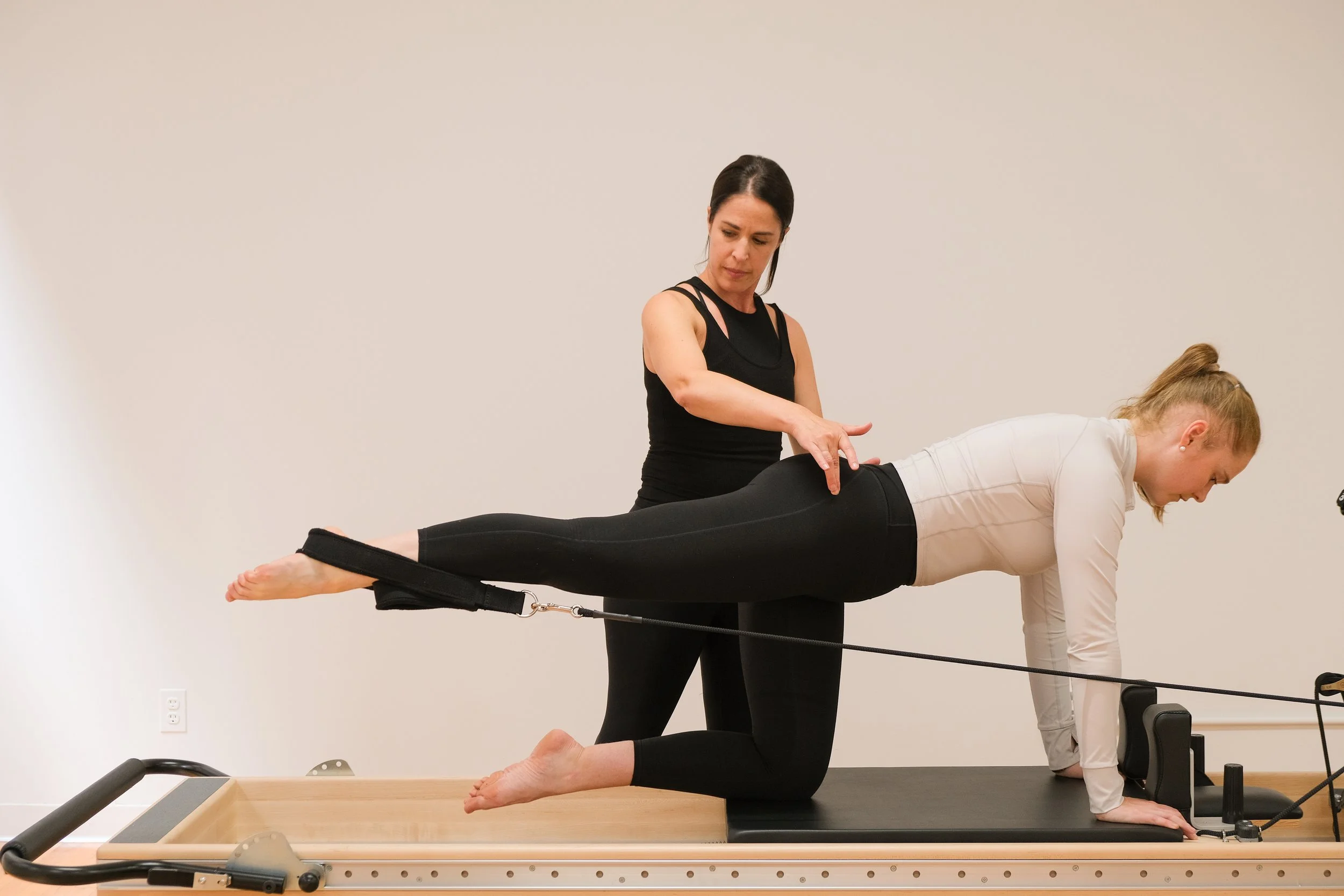
Reformer: A versatile machine with a sliding platform, springs, and pulleys, offering resistance and support. This is a favorite of the Pilates machines.
Cadillac: Also known as the Trapeze Table, used for more advanced exercises. Often hanging and used for some wonderful deep stretching
Tower: This is a portion of the Cadillac that allows you to push weight with the instability of the springs. It’s a great compliment to Reformer work and can be used to advance students to the rest of the equipment.
Magic Circle: A ring providing gentle resistance to improve muscle tone in exercises. This is a prop that is often added to your Pilates workouts. You’ve probably noticed one of these in the corner of your gym.
Which Type Of Pilates Is Right For Me?
Pilates comes in several forms, each offering distinct benefits:
Mat Pilates: Focuses on exercises performed on a mat, emphasizing core strength and flexibility. This is great for people who are already pretty strong (Mat when done well is quite difficult) and like being close to the floor/having a firm surface to work out on.
Reformer Pilates: Incorporates the Reformer machine for added resistance and support. The Reformer really challenges stability as you work on a moving platform. The weights can help you get stronger in exercises while also supporting your body in exercises that may not work on the mat just yet. It’s great for helping people build their balance, but it can also be a little scary in the beginning while getting used to the moving carriage.
Equipment Pilates: Tower, Cadillac, Chair, etc. Incorporates all of the Pilates Equipment to build a workout across multiple pieces. This becomes quite technical and unlocks the entire Pilates Repertoire.
Contemporary Pilates: Blends traditional Pilates with modern techniques and equipment. Follows less of a classical structure, incorporates weight training principles, and modern Physical therapy. Contemporary Pilates looks at Pilates as a workout or rehab. It closely follows changes in Physical Therapy and tries to bring those insights to training.
Classical Pilates: Follows Joseph Pilates' original teachings and sequences. The focus is on building and preserving Joseph’s original workouts from the 20th Century. The goal is to get “deeper” into the work instead of heavier. A workout is a byproduct but not necessarily the goal of a Classical session. Instructors will have a lineage that shows their style and who they trained under. It’s a long and vigorous certification of Joe’s original teachings.
Decide based on your fitness goals, physical condition, and personal preferences. If the original Method appeals, look into Classical Pilates and their Mat + Equipment Classes. If a sweaty workout appeals, look into Mat and Reformer Contemporary Classes.
Every piece of equipment and style has something to offer. It’s finding the one that works best for you. Look at the studios available in your area and see what aligns.
How to Prepare for Your First Pilates Class
First up, how exciting! Discovering Pilates can really be life-changing, starting with your first session.
Preparing for a smooth and enjoyable introduction to Pilates includes knowing what to wear to a Pilates class and what accessories you may need.
Studios will have different requirements, so definitely read up if they have any compulsory accessories. Some studios require you to bring your own mat or grip socks. It’s worth reading their Onboarding and booking notes before heading to your first session.
Essential Attire and Accessories for Pilates
Wear form-fitting, comfortable clothing that allows for a full range of motion. Opt for moisture-wicking fabrics to stay dry. Tight clothes allow your Instructor to fully see your body, specifically your rib cage and pelvic position. However, your comfort is a priority, so wear what you’ll be most comfortable moving in for the length of the session.
Pilates is usually done barefoot or with non-slip socks. Classical Studios allow bare feet, while many Contemporary Studios strictly enforce Grip Socks. You can get great Grip Socks for good prices on Amazon; otherwise, the studio likely sells them for $20-$35 if you forget them.
Finally, optional but useful. Bring a water bottle to stay hydrated and a small towel if you tend to sweat.
Physical and Mental Preparation Tips
Mentally prepare by setting realistic goals and maintaining a positive mindset. You’re trying something new, it won’t be perfect on Day 1.
Physically, ensure you’re hydrated and have had a light meal a few hours before class. If you don’t feel comfortable eating before core work, a banana or a handful of nuts can be a great snack to fuel you through.
Arrive early to familiarize yourself with the studio and equipment, and inform the instructor of any injuries or concerns. You’ll likely need to leave your belongings outside, put on your socks, and then make a few adjustments to your Reformer before getting started. Especially before your first class, you don’t want to be racing into the studio - get there early and chat to the Instructor first.
How Difficult Is Pilates? Managing Expectations
So hard is Pilates, really?
It’s as hard as you’d like to make it. Pilates is so customizable and has levels built into it - if you’re an athlete with a lot of flexibility, you’ll be able to listen to the progressions and amplify your workout further. If you’re brand new to movement, you can stay in the exercise or variation that makes the most sense to you.
You can turn the workout into a gentle mobility session or a sweaty core-focused workout based on your pacing, amount of rest, and the modifications/progressions that you take during the class.
Certain styles, studios, and teachers will all be known for their accessibility or high difficulty. If you’re unsure, I highly recommend emailing or calling the studio to ask about the Instructor who would be best for your level.
Physical Challenges for Beginners
Pilates can be challenging, especially for beginners. Expect to feel your muscles working in ways they have not before. You might experience soreness after your first few classes, but this is a sign of your body adapting and strengthening.
Communicate with your instructor, listen to your body, and take breaks as needed. Over time, consistency will lead to improved strength and endurance.
It will likely feel fun but a bit overwhelming in the beginning. The trick is to keep showing up and listening; the movements become more natural, and you’ll see the progression week after week.
After Your First Class: What Comes Next?
After completing your first Pilates class, consider the next steps in your Pilates journey.
Evaluating Your Experience and Planning Next Steps
Reflect on your first class experience. Consider what you enjoyed and any aspects you found challenging.
If your first experience didn’t feel quite right, we’d highly recommend trying another Studio or Instructor and seeing how it feels.
To progress, you’ll want to find a consistent studio and Instructor to follow. You want someone to fully understand your body and know how to push you. That comes from showing up consistently and building a rapport with your Instructor.
Discuss with your instructor how to tailor future sessions to your needs. Establish a regular Pilates routine to continue building strength, flexibility, and overall well-being.
If you’re Instructor understands your injuries and goals, they’ll be able to incorporate work into the workout to make sure you hit your goals and progress.
Closing Thoughts: Beginning Your Pilates Journey
Embarking on your Pilates journey can lead to numerous physical and mental benefits, from enhanced core strength to reduced stress. Remember to start at your own pace, stay consistent, and enjoy the process.
Get Started Today
Transform your fitness with Private 1x1 Pilates in NYC. At The Pilates Circuit, we deliver personalized one-on-one training designed around your body, your goals, and your progression. Whether you're improving posture, building strength, or enhancing mobility, every session is structured to drive measurable results.
Book an Intro Session to experience how targeted training can make a difference. Train with us at our Chelsea Private Pilates Studio or NOMAD Private Pilates Studio.
FAQs
-
The session will include a variety of exercises performed on the Pilates Reformer. The instructor will tailor the session specifically to your goals, abilities, and any concerns. You'll receive instruction on proper form, alignment, and breathing techniques for each exercise, ensuring safety and effectiveness.
Our instructors will play some music and chat with you throughout. You can chat as much or as little as you’d like.
Depending on your personal goals you’ll repeat exercises each week to try and get you there. Coming in tired, your instructor will switch up the routine to match you where you are.
Lots of energy? Let’s go!
-
Private Pilates training offers personalized attention, customized workouts, and the ability to progress at your own pace. With a private instructor, you receive individualized instruction tailored to your body's needs and goals.
This allows for a more effective and efficient workout. Private sessions also provide a focused environment where you can address specific areas of concern, such as injury rehabilitation.
Group classes focus on choreography and keeping the entire group moving. If you’re after more, private pilates will be personalized to you.
-
Ultimately, the ideal frequency will vary depending on your personal goals, but it is important to find a balance that works for you and prioritizes recovery.
You can aim to add around 2 - 3 sessions per week, incorporating them into your overall fitness routine for optimal results.
-
Pilates is not as high-impact or cardio-intensive as some other forms of exercise like running or high-intensity interval training, so you may not sweat as much during a Pilates session compared to those activities.
The intensity of sweating can also vary depending on the intensity of the exercises, room temperature, and individual differences in metabolism and perspiration.
But trust us, you’ll be working hard just not Hot Yoga level sweating.
-
Pilates and Yoga have some similarities, but are not the same exercise form. Pilates and Yoga both focus on mind-body connection, breath control, and movement.
However, Pilates emphasizes core strength, stability, and controlled movement, while Yoga focuses more on flexibility, balance, and spiritual aspects. Fundamentally Pilates is a workout, Yoga is a spiritual practice.
